Ben Nevis: A Beginner’s Guide

For many UK walkers, Ben Nevis is the top dog. As the tallest peak in the United Kingdom, reaching the summit is a real challenge and an unforgettable experience. While we may be slightly biased toward Yr Wyddfa (Snowdon), Ben Nevis is undoubtedly a spectacular walk and we love all the time we spend in that beautiful part of the world. We recommend it to anyone who loves walking and a long day out in the mountains.
If you are considering taking on Ben Nevis as a relatively new walker, there are a few things you should know. In this beginner’s guide, we give you a complete rundown of all the essential information, from what route to choose to the best time of year to climb Ben Nevis and where to stay.
Ben Nevis – the essentials
The tallest mountain in the UK, Ben Nevis tops out at 1,345 metres, making it the highest point for 700 km in any direction. You have to go all the way to Norway before you hit a bigger mountain. Located just outside Fort William, Ben Nevis is one of the Three Peaks, alongside Yr Wyddfa and Scafell Pike.
For many, its appeal lies in its sheer height. But there is a lot more to it than that. The mountain is part of the breathtaking Grampian mountain range and is a wonderful introduction to Scotland’s rugged and wild Highlands. Offering spectacular views over the surrounding landscape, reaching the summit is a jaw-dropping moment for those who have never walked that high or experienced the true majesty of the mountains.
There is also the fact that Ben Nevis is an achievable target for relatively inexperienced climbers. You don’t have to be a lifelong mountaineer to get to the top.
How difficult is Ben Nevis?
Given the right conditions, summiting Ben Nevis is achievable for most walkers with a reasonable fitness level. That’s not to say it is easy, though. As the tallest mountain in the UK, it poses a decent challenge for most. Like most mountains, how difficult the climb is depends on several factors. With Ben Nevis, there are three crucial considerations.
- Route – the route you select will determine the overall difficulty. While the Mountain Path is achievable for most, Càrn Mòr Dearg Arete and Tower Ridge typically require specialist rock climbing equipment and considerable experience.
- Weather – clear skies and reasonable temperatures make the climb much easier. Especially low or high temperatures add to the difficulty, while snow guarantees extra complexity and low visibility conditions can cause real problems for inexperienced walkers.
- Fitness – your personal fitness is a pretty influential factor in how challenging you will find the walk. Ben Nevis will be tough if you are not a frequent hillwalker. On the other hand, if you are used to continental alpine treks, it won’t pose a problem.
We recommend thinking about all these factors when considering whether you are ready to climb Ben Nevis. If you are still unsure, contact the RAW Adventures team. We can talk you through the relevant details and point you towards walks and experiences that may help you prepare and build your confidence. If you are wondering how Ben Nevis compares to Yr Wyddfa, check out our blog on the subject.
Routes
Ben Nevis boasts several summit routes, ranging from the relatively straightforward and accessible to those that only experienced mountaineers should attempt. For beginners, the Mountain Path is the clear favourite. However, we will also provide brief descriptions of the alternatives, ensuring you have a complete picture of the available trails.
The Mountain Path
Also known as the Pony Track or Ben Path, the Mountain Path is the best route for beginners and the most popular way up the mountain. The out-and-back route is roughly 16 km (10 miles) long and involves approximately 1,340 metres of ascent. Walkers typically complete the route in seven to nine hours.
The Mountain Path begins at the Ben Nevis Visitor Centre and benefits from excellent signage and a relatively easy-to-follow track. From the Visitor Centre, cross the bridge, take the first right and follow the path as it bends to the left. Keep on the path as you cross the road that leads to the Ben Nevis Inn (you can stop for a well-earned refreshment on the way back down) and follow the rocky path southeast. After crossing several stiles, the path gets steeper and zig zags through woodland. Emerging from the woodland, you will see the famous Halfway Lochan – a great spot to stop, tuck into a snack, rest your legs and soak up the surroundings.
Having taken a moment to appreciate the Grampians’ beauty, it is time to hit the trail again. Above the Halfway Lochan, you will reach a junction. Turn right and head south, climbing on a rocky path that soon begins to switchback up the mountainside. Cairns flank the path to help you stay en route. But this is a tricky section to navigate if visibility is low (and has been the scene of numerous accidents, especially in early season when snow is still present and hiding the dangers – take care!). This path will lead you to the summit. Congratulations!
To descend the mountain, follow the same route, retracing your steps back to the visitor centre. However, be careful when initially navigating your way off the summit, as there are several dangers. Most notably, Gardyloo Gully, Coire Eoghainn and Five Finger Gully. While these areas are not usually problematic on good days, they can pose a real threat in low visibility conditions. In these cases, a map, compass and the skills required to use them accurately are essential. While GPS devices can assist, they have been known to lead walkers into danger on the summit. Once you are off the summit plateau and back on the Mountain Path, following the route back should be fairly straightforward.
Càrn Mòr Dearg (CMD) Arête
The Càrn Mòr Dearg Arête starts from the North Face car park and is approximately 18 km (11 miles) long, with 1,500 metres of ascent. It takes around 10 hours to complete in good summer conditions. The walk is relatively non-technical until you reach the summit of Càrn Mòr Dearg and tackle the arête, a slender ridgeline walk that features significant exposure and requires some scrambling and a good head for heights. While this is not one for newer walkers, it generally does not require any specialist equipment.
Ledge Route
The Ledge Route is something of a halfway house between the Mountain Track and the CMD Arête. It is roughly 12 km (7.5 miles) long and can take anywhere from seven to nine hours to complete. While it does not feature the same level of exposure as the CMD Arête route, it includes some steep scrambling and is much more a direct ascent than the Mountain Path. We’d recommend being guided up this by a member of the Association of Mountaineering Instructors unless you have extensive knowledge of using a rope to safeguard your party in consequential scrambling ground.
Tower Ridge and North Face routes
The Tower Ridge and North Face routes are climbing routes that require specialist equipment and mountaineering expertise. They typically begin from Torlundy or the North Face car park and are unsuitable for beginner walkers or those without mountain experience. But you might be able to tackle these if accompanied by a suitably experienced instructor.
Weather considerations
The weather (and how prepared you are for it) is one of the most important factors influencing how much you enjoy your Ben Nevis experience. It is also the thing that catches beginners out. It is not uncommon for walkers to depart Fort William in beautiful sunshine only to discover that the weather at the summit is entirely different. At best, this makes for a more uncomfortable experience. At worst, it can be a real safety concern. With this in mind, here are a few things you should know about the weather on Ben Nevis.
- • It is extremely changeable. Don’t ever bank on it being the same on the summit as when you start your climb. It will be about 12 degrees colder, for starters!
- • Always check the weather forecast before starting your walk. We recommend the Mountain Weather Information Service (MWIS) and Windy. The Met Office also has dedicated mountain forecasts.
- • Visibility is not always great on and around Ben Nevis. If there is any likelihood of reduced visibility, you must be comfortable using a map and compass to navigate.
The best time of year to climb Ben Nevis
Finding the best time to climb Ben Nevis involves balancing the weather and the crowds. While midsummer tends to provide the best conditions, it is also when most people hit the trails. As a result, we think the spring and autumn shoulder seasons are the best time to head to the summit.
Spring (May – June)
Spring is arguably your best chance of reaching the summit in pleasant weather and seeing relatively few people along the way. Conditions are more stable (though still very changeable compared to lowland areas), the midges are yet to arrive in full force, and you have a good daylight window for your climb. The closer you are to winter, the more likely there will be snow close to the summit, adding to the challenge. You should take this into consideration if you do not have experience walking in the winter conditions.
Summer (July – August)
Summer is peak walking season and the trails on Ben Nevis really come alive. How much this foot traffic puts you off comes down to what you want from your mountain experience. If you enjoy the solitude of the mountains, it is probably not the best time for you. If you are committed to walking in summer, set off as early as possible to lessen the impact.
Autumn (September – October)
Following the summer crowds, autumn is a welcome return to a more peaceful mountain experience. However, the season is short-lived. The weather typically becomes more unpredictable towards the end of September, making it much less suitable for inexperienced walkers. If you are lucky, the autumn window may extend into early October. But this is a rare occurrence. The first snows of the year tend to arrive on the summit in late September.
Winter (October – April)
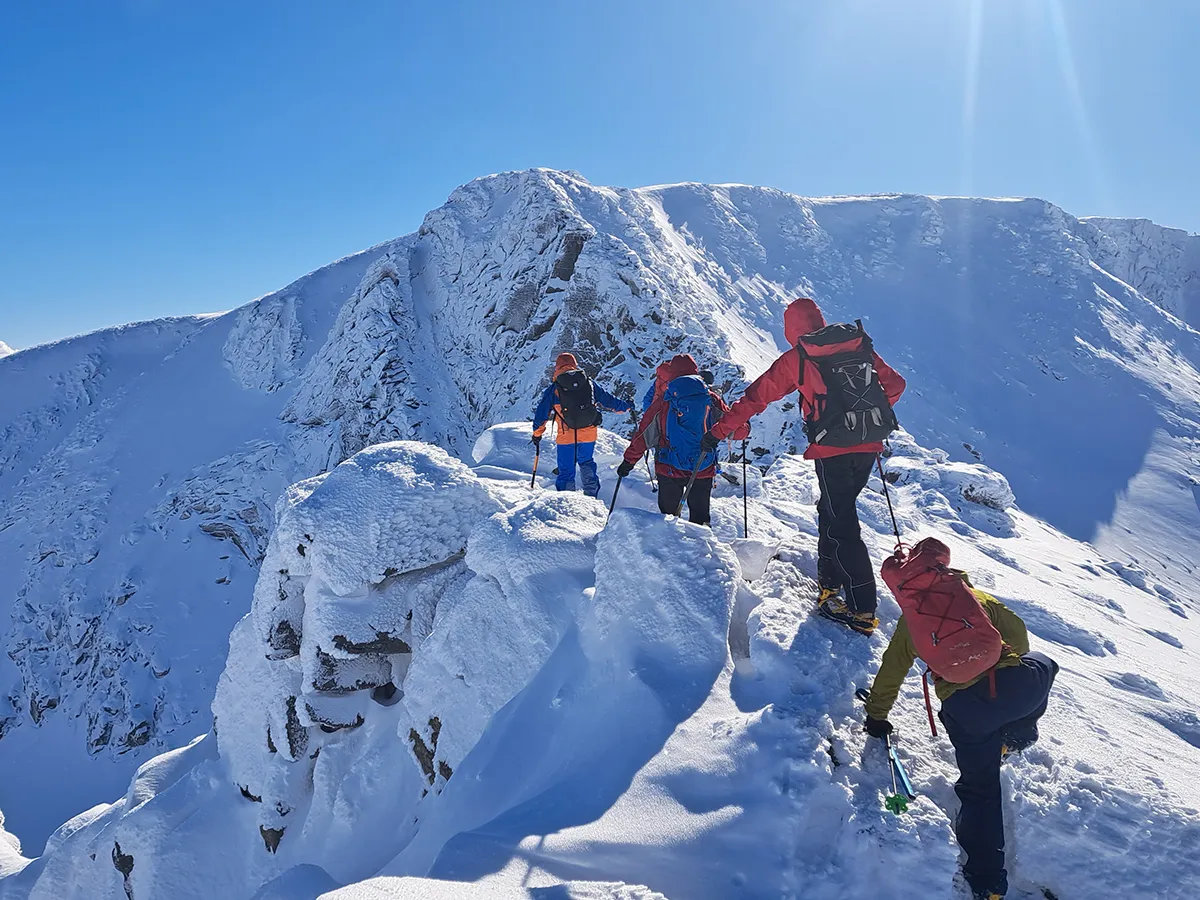
Winter in the Grampians is long and challenging. Due to the conditions, Ben Nevis is unclimbable for those without mountaineering experience, crampons, ice axes and other winter equipment.
How to get there
Fort William is the gateway to Ben Nevis for most visitors. It is the closest town to the mountain and the main transport hub in the area. You can drive out to the trailheads from Fort William and local buses are also an option. You can even walk from the town to the trailhead – the trek is just 3 km.
If you are considering driving, there is parking at the Ben Nevis Visitor Centre, as well as several other car parks nearby. If you opt for the train, you will probably travel via Glasgow and transfer to your local Fort William connection.
Where to stay
People travel from all over to climb Ben Nevis, so there are quite a few accommodation options. For a budget-friendly stay close to the mountain, the Glen Nevis Hostel is an excellent choice. The Ben Nevis Inn also puts you right at the foot of the Mountain Path. If you want to be a little closer to Fort William while remaining within easy reach of the trails, Brevins Guest House is a good bet. There is also plenty of accommodation in Fort William itself. Glen Nevis Campsite is the closest option if you fancy sleeping under canvas.
Guided Ben Nevis walks with RAW Adventures
Reaching the Ben Nevis summit is achievable for most people without a guide. With a reasonable fitness level and the right conditions, the Mountain Path is not insurmountable. However, we firmly believe guides improve every walker’s Ben Nevis experience. Particularly when it comes to beginners. Why? For the following reasons:
- Peace of mind – experienced mountain leaders make the right call at the right time. They are trained to read the conditions, understand the environment and keep you safe.
- Support and assistance – reaching the summit is a physical challenge and many walkers benefit from the support, motivation and confidence mountain leaders offer.
- Insight – there is so much to see and experience on the mountain and most people walk straight by because they simply don’t know something is there. From local history and natural landmarks to wildlife and the mountain ecosystem, guides give you an entirely different perspective on the environment.
- Simplicity – on guided walks, the guides are responsible for timings, navigation and other logistical issues that can be a pain to organise. They take a weight off your shoulders and enable you to fully enjoy the experience.
- A learning opportunity – mountain leaders are highly qualified and spend a lot of time in this environment. As such, they can teach you a lot. From helping you work out what equipment to bring to improving the way you move across terrain, there are a tonne of tips, tricks and techniques they can teach you.
Our team of local mountain leaders have been guiding adventurers up Ben Nevis for over 15 years. Whether you’re a beginner or have climbed Ben Nevis before – our intimate knowledge of this special landscape means you’ll always get a new perspective, and can immerse yourself in ‘The Ben’ experience, without worrying about navigation or route planning. Find out more.
Explore More
Categories
More Guides & News
Are Winter Skills Courses Worth It?
This guide introduces the concept of a Winter Skills Course, and why and how this specific input could really help to increase knowledge and confidence for mountain walking in the winter months. Read on to find out what you can learn from attending, and how this experience can extend to year-round adventures.

Six Routes. One Unique Mountain Challenge
Designed and delivered exclusively by RAW Adventures, the Snowdon 6 Challenge invites you to explore six of the mountain’s most iconic routes – all in one incredible, fully-supported day. And now, thanks to our charity partner The Joshua Tree, you’ve got a rare opportunity to be part of something even more meaningful…

Marching Together Skyline Heroes Hike
TSSI Recruit, a global leader in telecoms, IT, and digital staffing, is stepping up with a team of recruits, ready to band together, push limits, and support veterans through HELP for HEROES. Their mission? To channel their core company values into every stride they take.
Instagram
#QuitTalkingStartDoing